
Whale shark season
Rhincodon typus
The world's largest fish. Summer visitor to the Red Sea, peak July to September. Filter feeder, completely harmless. The encounter divers describe in single sentences for the rest of their lives.
Whale sharks visit the Egyptian Red Sea between May and October, with peak sightings in July, August, and September. They're filter feeders · they cruise the surface at 0-10 m hoovering up zooplankton and fish eggs · so the encounters happen at snorkel depth, not on a deep wall. Around Hurghada the sightings are sporadic (we've logged 8-12 per season recently); for reliable encounters serious whale-shark divers head south to Marsa Alam where the cleaning station at Hamata produces multiple weekly sightings in season.
The whale shark is the largest fish in the world · adults reach 12-14 m and weigh 15-20 tonnes. They're sharks (cartilaginous, not bony fish) but evolved to filter-feed like baleen whales, swimming with their massive mouths open and straining microscopic food from the water. Despite the size and the name they're harmless to divers · no teeth that can cut a person, no aggression, no territoriality.
Individual whale sharks are identifiable by the unique pattern of white spots on their flanks · researchers use these patterns the way mammalogists use facial photographs. Most Red Sea individuals appear in the species ID database (whaleshark.org) and follow predictable seasonal migration routes. The Hurghada area sees mostly juveniles and sub-adults (4-7 m); the bigger adults are seen further south.
When you encounter one, the experience is straightforward: a shape larger than the boat appears in the blue, glides past at walking pace, and you swim alongside (never in front, never blocking the path) for 30-60 seconds before it disappears back into deeper water. The brain takes weeks to process what happened.
Sightings around Hurghada are sporadic and not tied to specific dive sites · whale sharks cruise the open water between reefs following plankton blooms. Most encounters in our captain's logbook have happened on the longer-transit days (Carless Reef, Umm Gamar, Abu Nuhas runs) where the boat passes through more open water. We don't have a 'whale shark site' to direct you to; we ask the captain to keep eyes on the surface during transit on those days.
May to October. Peak July-September. Almost never in winter (the species follows zooplankton concentrations which peak in summer in the northern Red Sea). For the highest encounter probability per trip, plan a Hurghada visit in late August or September.
Sighting chance by month
- Jan—
- Feb—
- Mar—
- Apr•
- May••
- Jun••
- Jul•••
- Aug•••
- Sep•••
- Oct•
- Nov—
- Dec—
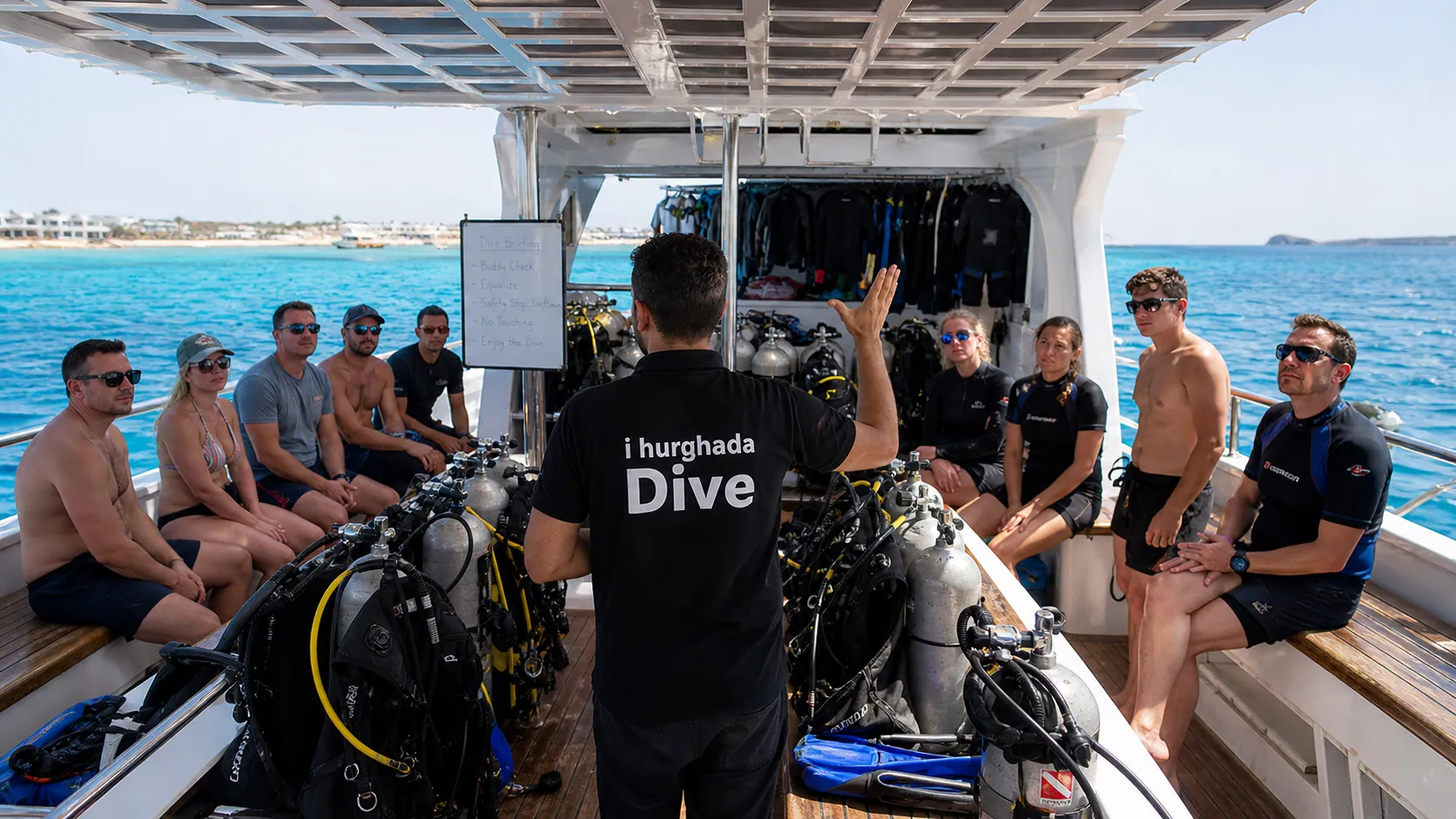
Whale sharks are protected species in Egyptian waters. Code of conduct: no touching, no chasing, no flash photography, maintain at least 3 m distance, never block the swim path. We brief this before every potential encounter. If the animal changes direction sharply or arches its body, that's a stress signal · we back off and let it leave.
Which species do you want to see?
Tell us the species and the date · the captain plans the boat around the conditions.